

Educational content for students. Not medical or coding advice. Having symptoms? See the patient guide.
Three terms, one word part apart. The difference is timing (during periods vs between them) and amount.
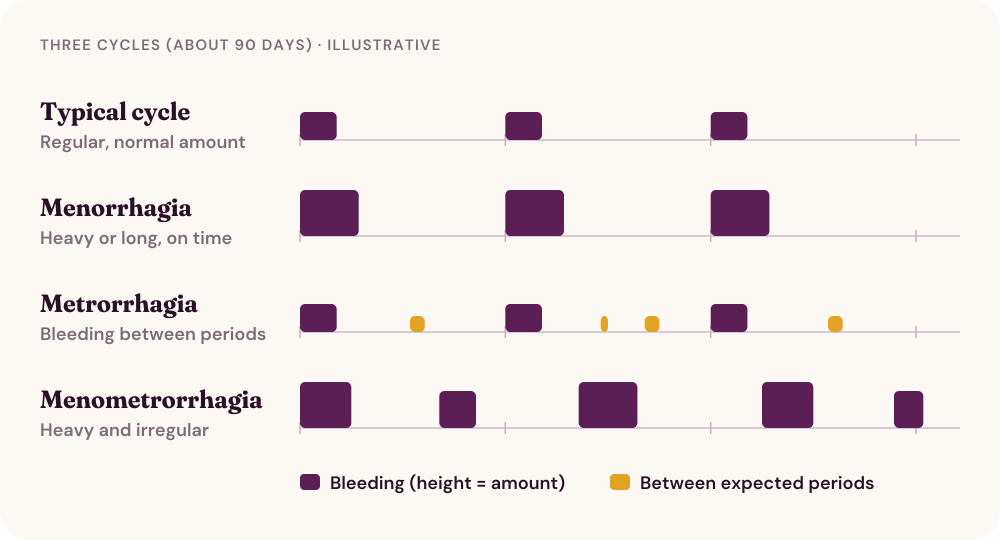
The comparison table
| Menorrhagia | Metrorrhagia | Menometrorrhagia | |
|---|---|---|---|
| Word parts | men/o + -rrhagia | metr/o + -rrhagia | men/o + metr/o + -rrhagia |
| When | During the period | Between periods, at irregular times | During and between periods |
| Amount | Heavy and/or prolonged | Often light to moderate, can vary | Heavy and/or prolonged |
| Cycle pattern | Regular | Irregular | Irregular |
| Modern FIGO term | Heavy menstrual bleeding (HMB) | Intermenstrual bleeding (IMB) / irregular bleeding | HMB with irregular bleeding |
| ICD-10-CM | N92.0 (menorrhagia NOS) | N92.1 | N92.1 |
FIGO terminology: FIGO 2018. ICD-10-CM inclusion terms: N92. Cleveland Clinic describes menorrhagia as heavy bleeding during your period and menometrorrhagia as irregular or unpredictable bleeding that can occur at any time [Cleveland Clinic].
Menorrhagia = monthly flow too heavy. Metrorrhagia = the uterus bleeds when it shouldn't. Both together = menometrorrhagia.
Other cycle terms to know
| Term | Meaning | ICD-10-CM pointer |
|---|---|---|
| Polymenorrhea | Abnormally frequent periods | N92.0 (inclusion term) |
| Oligomenorrhea | Infrequent periods | N91.3–N91.5 range |
| Amenorrhea | Absence of periods | N91.0–N91.2 |
| Ovulation bleeding | Regular, predictable mid-cycle bleeding | N92.3 |
| Postcoital bleeding | Bleeding after sex | N93.0 |
| Postmenopausal bleeding | Bleeding after menopause | N95.0 |
See the ICD-10 page for the full list and the Excludes1 notes.
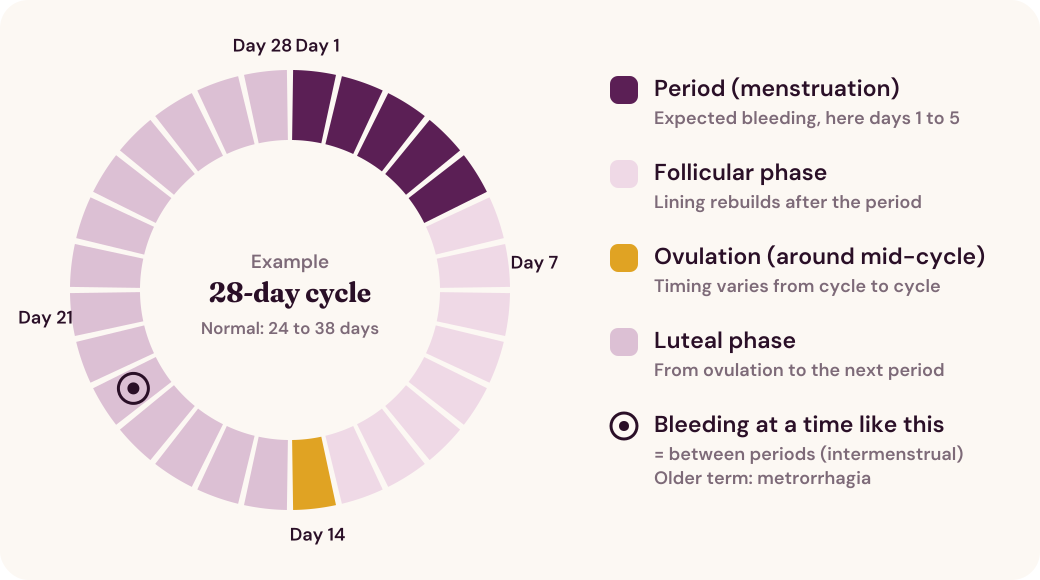
What counts as "normal" anyway?
Definitions vary by source. ACOG's patient FAQ uses a cycle of 21–35 days and a period of up to 7 days [ACOG]. FIGO's 2018 system defines normal frequency as 24–38 days and normal duration as up to 8 days [FIGO 2018], and ACOG's perimenopause FAQ uses the same 24–38 days and up to 8 days [ACOG]. On an exam, use the figures your course textbook gives.
Sources
- The two FIGO systems for normal and abnormal uterine bleeding symptoms and classification of causes of AUB in the reproductive years: 2018 revisions Munro MG et al., Int J Gynecol Obstet 2018
- ICD-10-CM N92 Excessive, frequent and irregular menstruation (N92.0–N92.6) ICD10Data.com, FY2027 code set
- Menometrorrhagia (Abnormal Uterine Bleeding) Cleveland Clinic Health Library, Nov 2024
- Abnormal Uterine Bleeding (FAQ095) American College of Obstetricians and Gynecologists, reviewed Aug 2025
- Perimenopausal Bleeding and Bleeding After Menopause American College of Obstetricians and Gynecologists
We link to primary medical sources so you can check our work. See the editorial policy and the full reference list.