

Educational content for students. Not medical or coding advice. Having symptoms? See the patient guide.
On this page
Textbook definition
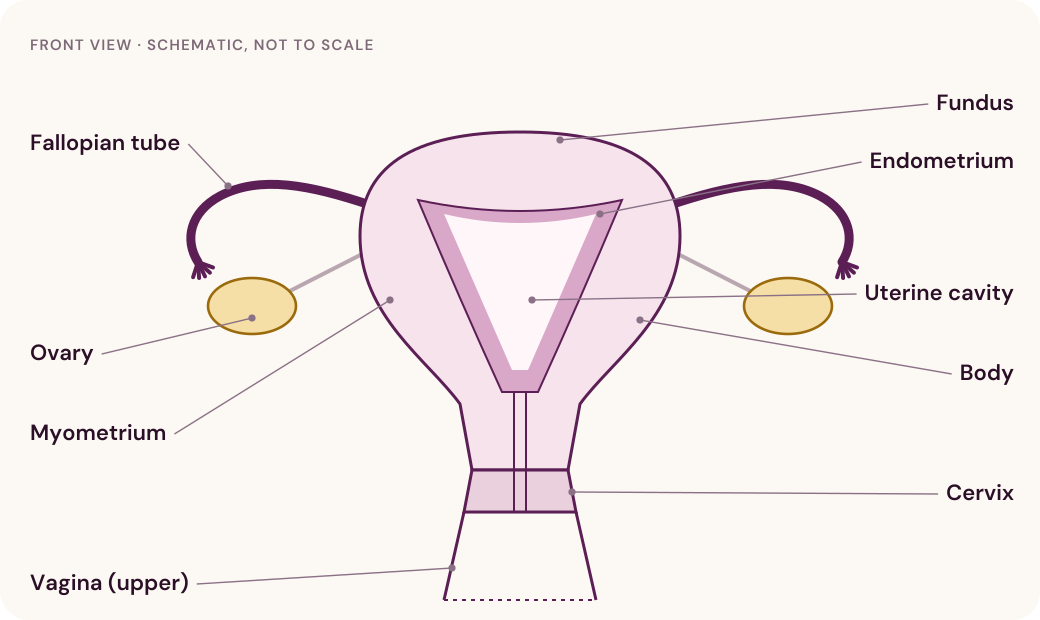
Metrorrhagia is uterine bleeding at irregular intervals, especially bleeding that occurs between expected menstrual periods. The U.S. National Library of Medicine's MeSH vocabulary defines it as "abnormal uterine bleeding that is not related to menstruation, usually in females without regular menstrual cycle," and notes that "the irregular and unpredictable bleeding usually comes from a dysfunctional endometrium" [MeSH].
Plain-English definition
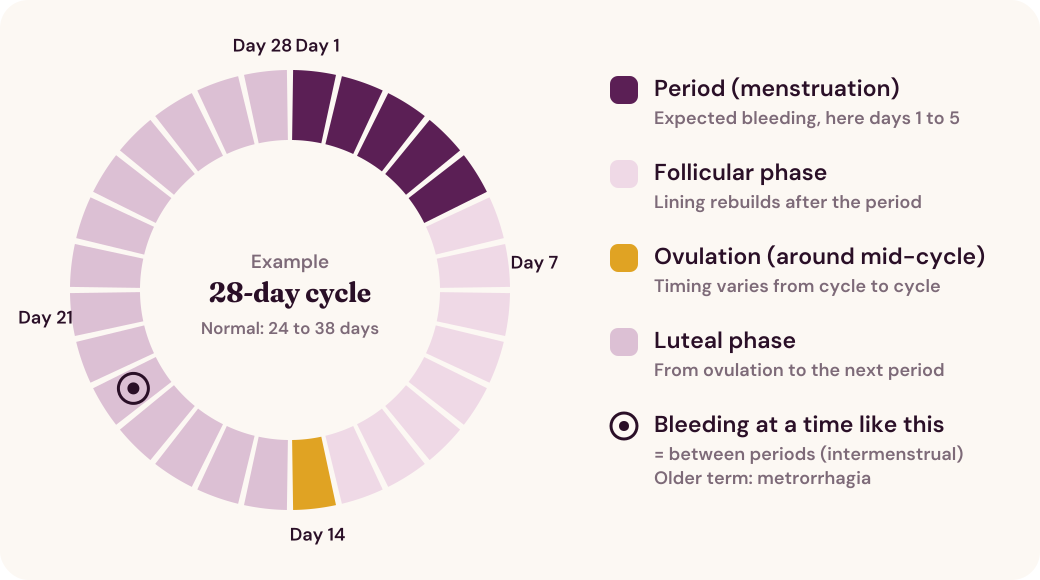
Bleeding or spotting from the uterus at times when you wouldn't expect a period. That's why the everyday phrase is bleeding between periods.
Synonyms and related entry terms
MeSH lists these entry terms under Metrorrhagia: bleeding between periods, breakthrough bleeding, dysfunctional uterine bleeding, intermenstrual bleeding, and spotting [MeSH]. In practice they aren't perfect synonyms. "Breakthrough bleeding" usually refers to bleeding on hormonal contraception [ACOG], and "dysfunctional uterine bleeding" is a term FIGO recommends abandoning [FIGO 2018].
| Item | Value |
|---|---|
| Pronunciation | MEE-troh-RAY-jee-uh (also MET-roh-RAY-jee-uh) |
| Part of speech | Noun |
| Adjective | metrorrhagic |
| Body system | Female reproductive system |
| ICD-10-CM | N92.1 (inclusion term) [ICD-10-CM] |
| MeSH | D008796 [MeSH] |
| Modern (FIGO) equivalent | Intermenstrual bleeding (IMB) or irregular bleeding, under the umbrella of abnormal uterine bleeding (AUB) [FIGO] |
Using it in a sentence
"Patient reports metrorrhagia for three cycles: light bleeding on days 12–15 in addition to normal menses."
In current clinical notes you'll increasingly see the FIGO wording instead: "intermenstrual bleeding" or "AUB with irregular bleeding" [FIGO]. See modern terminology.
Metrorrhagia is a symptom, not a diagnosis. It describes when bleeding happens, not why. The cause is classified separately, for example with PALM-COEIN [StatPearls].
Sources
- Metrorrhagia (MeSH Descriptor D008796) U.S. National Library of Medicine
- Abnormal Uterine Bleeding (FAQ095) American College of Obstetricians and Gynecologists, reviewed Aug 2025
- The two FIGO systems for normal and abnormal uterine bleeding symptoms and classification of causes of AUB in the reproductive years: 2018 revisions Munro MG et al., Int J Gynecol Obstet 2018
- ICD-10-CM N92 Excessive, frequent and irregular menstruation (N92.0–N92.6) ICD10Data.com, FY2027 code set
- Abnormal Uterine Bleeding StatPearls, NCBI Bookshelf (NBK532913)
We link to primary medical sources so you can check our work. See the editorial policy and the full reference list.