

Educational content for students. Not medical or coding advice. Having symptoms? See the patient guide.
On this page
If your textbook teaches "metrorrhagia" but your clinical placement says "intermenstrual bleeding," here's why.
The problem with the old words
Terms such as menorrhagia, metrorrhagia and dysfunctional uterine bleeding were used inconsistently around the world, which made research and communication confusing [FIGO 2011] [Frontiers 2022]. FIGO (the International Federation of Gynecology and Obstetrics) therefore recommended replacing them with plain descriptive terms. Its 2018 revision discards menorrhagia, metrorrhagia and dysfunctional uterine bleeding [FIGO 2018].
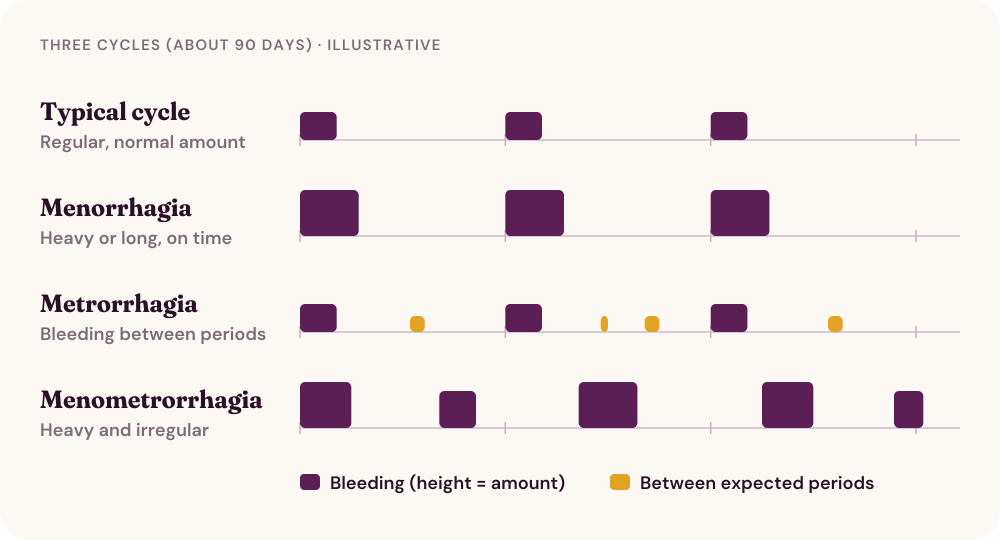
FIGO System 1: describing the bleeding
Bleeding is described on four parameters, plus intermenstrual bleeding [FIGO 2018]:
| Parameter | Normal (FIGO 2018) | Abnormal descriptors |
|---|---|---|
| Frequency | 24–38 days | Absent (amenorrhea), infrequent (>38 days), frequent (<24 days) |
| Duration | Up to 8 days | Prolonged (>8 days) |
| Regularity | Shortest to longest cycle varies by ≤7–9 days (depending on age) | Irregular |
| Volume | Normal for the patient | Heavy or light |
| Intermenstrual bleeding | None | Random or cyclical (predictable early, mid or late cycle) |
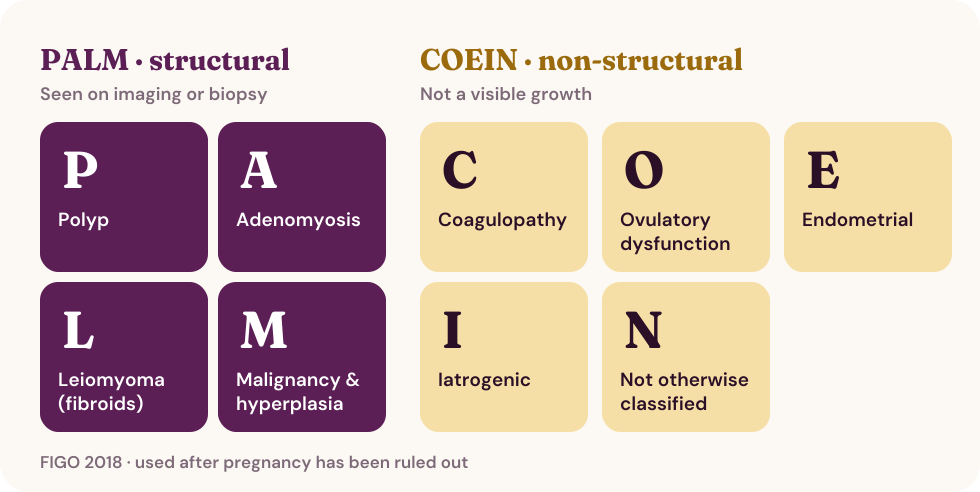
FIGO System 2: classifying the cause
Causes are grouped with the acronym PALM-COEIN [FIGO] [StatPearls]. See causes.
Old term → new term
| Traditional | FIGO-style description |
|---|---|
| Metrorrhagia | Intermenstrual bleeding (IMB), or irregular bleeding |
| Menorrhagia | Heavy menstrual bleeding (HMB) |
| Menometrorrhagia | HMB with irregular / intermenstrual bleeding |
| Polymenorrhea | Frequent menstrual bleeding |
| Oligomenorrhea | Infrequent menstrual bleeding |
| Dysfunctional uterine bleeding | AUB with a specific PALM-COEIN cause (for example AUB-O, ovulatory dysfunction) |
ICD-10-CM still uses the traditional words as inclusion terms (for example "Metrorrhagia" under N92.1) [ICD-10-CM]. Coders need to recognise both vocabularies.
Sources
- The FIGO recommendations on terminologies and definitions for normal and abnormal uterine bleeding Fraser IS et al., Semin Reprod Med 2011 (PubMed 22065325)
- Historical Perspectives and Evolution of Menstrual Terminology Frontiers in Reproductive Health, 2022
- The two FIGO systems for normal and abnormal uterine bleeding symptoms and classification of causes of AUB in the reproductive years: 2018 revisions Munro MG et al., Int J Gynecol Obstet 2018
- Abnormal Uterine Bleeding StatPearls, NCBI Bookshelf (NBK532913)
- ICD-10-CM N92 Excessive, frequent and irregular menstruation (N92.0–N92.6) ICD10Data.com, FY2027 code set
We link to primary medical sources so you can check our work. See the editorial policy and the full reference list.