
Educational content for students. Not medical or coding advice. Having symptoms? See the patient guide.
On this page
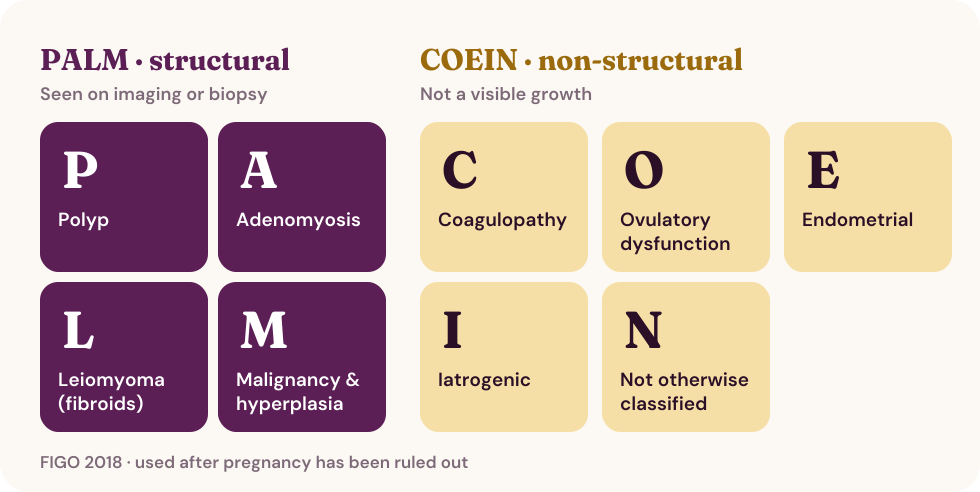
Metrorrhagia describes the bleeding pattern. Clinicians then look for the cause. FIGO's PALM-COEIN system sorts causes of abnormal uterine bleeding in non-pregnant people of reproductive age into structural (PALM) and non-structural (COEIN) groups [FIGO 2018] [StatPearls].
PALM: structural causes
| Letter | Cause | Notes |
|---|---|---|
| P | Polyp | Benign growths of the endometrium or cervix. Can cause irregular bleeding or bleeding after sex [ACOG]. |
| A | Adenomyosis | Endometrium growing into the uterine wall. Heavy, painful periods [ACOG]. |
| L | Leiomyoma (fibroids) | Benign muscle tumours of the uterus [ACOG] [NHS]. |
| M | Malignancy and hyperplasia | Endometrial hyperplasia or cancer, more likely around and after menopause [ACOG] [ACOG]. |
COEIN: non-structural causes
| Letter | Cause | Notes |
|---|---|---|
| C | Coagulopathy | Bleeding disorders such as von Willebrand disease [StatPearls] [ACOG]. |
| O | Ovulatory dysfunction | Irregular or absent ovulation, common in adolescence and perimenopause and in PCOS or thyroid disease [ACOG]. |
| E | Endometrial | Primary disorders of the endometrium, including inflammation or infection [StatPearls]. |
| I | Iatrogenic | Caused by treatment: hormonal contraception, IUDs, anticoagulants, tamoxifen and others [ACOG] [Cleveland Clinic]. |
| N | Not otherwise classified | Rare or poorly defined causes [FIGO]. |
Always rule out pregnancy first
PALM-COEIN applies to non-pregnant patients. Pregnancy-related bleeding (including miscarriage and ectopic pregnancy) is considered first, which is why a pregnancy test is a standard early step [StatPearls] [ACOG] [NHS].
Other causes students should list
- Infections, including sexually transmitted infections such as chlamydia, cervicitis and PID [NHS] [Cleveland Clinic].
- Cervical causes such as ectropion or polyps, especially for bleeding after sex [NHS].
- Systemic conditions: thyroid, liver or kidney disease [Cleveland Clinic].
"PALM you can see (on imaging or biopsy); COEIN you can't."
Patient-facing version: bleeding between periods.
Sources
- The two FIGO systems for normal and abnormal uterine bleeding symptoms and classification of causes of AUB in the reproductive years: 2018 revisions Munro MG et al., Int J Gynecol Obstet 2018
- Abnormal Uterine Bleeding StatPearls, NCBI Bookshelf (NBK532913)
- Perimenopausal Bleeding and Bleeding After Menopause American College of Obstetricians and Gynecologists
- Abnormal Uterine Bleeding (FAQ095) American College of Obstetricians and Gynecologists, reviewed Aug 2025
- Fibroids NHS
- Menometrorrhagia (Abnormal Uterine Bleeding) Cleveland Clinic Health Library, Nov 2024
- Vaginal bleeding between periods or after sex NHS, reviewed Aug 2024
We link to primary medical sources so you can check our work. See the editorial policy and the full reference list.